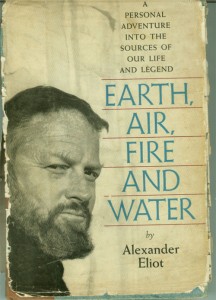
 Born April 28, 1919, in Cambridge, Massachusetts, Alexander Eliot has published eighteen books on art, mythology, history, and two novels. Also the author of hundreds of published essays in magazines as varied as Atlantic Monthly, The Eastern Buddhist, Life, Life International, Sports Illustrated, Time, Newsweek,Travel & Leisure, Gourmet, Horticulture Magazine, Parabola, Smithsonian, Texas Quarterly, Italy’s Panorama, and England’s Systematics and Man, Myth and Magic.
Eliot’s father was a professor at Smith College, Northampton, MA; his great-grandfather was president of Harvard for forty years. He attended Black Mountain College to study art with abstract painter Josef Albers. He left two years later to attend Boston Museum School, and afterward opened an art gallery in Boston before moving to New York City.
 Time Magazine: From age 26 to 42 (1945-1960) Eliot was the art editor at Time Magazine, during which time he socialized with and wrote about every major American (and European) artist. Salvador Dali became a special friend not only because of their shared passion for art but also because Eliot’s wife, Jane Winslow, had lived for several years in Catalonia and spoke Dali’s native Catalan fluently. Eliot’s stories of encounters and interviews with Picasso, de Kooning, Matisse, and many others have enthralled friends and family all his life.
In 1960 he was awarded a Guggenheim Fellowship to research “Studies of Greece and the Middle East as Spiritual Cradles of the Western World.” While he was there he and his wife, Jane Winslow Eliot, visited Delphi, and decided they wanted to raise their family in Greece.
 So, he took early retirement from Time Inc. at age 42, moved to Greece with his family, and continued to write and travel, determined to explore, with his wife, Jane Winslow Eliot, most sacred places in the world. He continued to write and research and explore spirituality, myth, love, and life.
Alexander Eliot, who said: “Life is a fatal adventure. It can only have one end. So why not make it as far-ranging and free as possible?”
 Alexander Eliot, perhaps best known for this unorthodox biography in Who’s Who In America and Who’s Who in the World: “The sun shines on me and in me as well. But what am I? A goose-pimpled crazy on a skewed glass bicycle, continually crashing into scribbled walls. And this being, this moment is the thing.”
Great blog, I have just bookmarked it 🙂
Great Blog. interested to read your book “The Global Myths: Exploring Primitive, Pagan, Sacred, and Scientific Mythologies”.
Can you tell me where A. Eliot wrote (circa 1962) about the statue of Hermes and the Baby Dionysus by Praxiteles–showing that the statue in the Olympia Museum is a copy after all.
Thinking about you and often sir! Hope all is well! :)David Hinnebusch – A painter you met on the beach ten years ago!
In the ’80s , I came across a book in a dusty Brisbane bookshop
titled “Zen Edge”. Forgot about it. 34 years later I unpacked
it in Montreal & it’s …well, like a breath
of fresh air …a poor simile, but words fail.
It doesn’t seem to feature among your books, but it’s your
‘style’. Are you the author?
Winslow Eliot replies: “My father, Alexander Eliot, IS the author of Zen Edge, and he is going to be delighted when I read him what you wrote. Last week he celebrated his 95th birthday … still going strong and writing every day. Thank you so much writing to him – as I say, he’ll be so happy to get this.”
Oh, it’s my turn to be delighted!!! Thank you for
passing on the message to your father.
Please add my most esteemed (belated) birthday wishes
Dear Winslow Eliot:
What a gift to the world is your beyond brilliant Father, the irreplaceable, Alexander Eliot.
In a world of so-called “Art Historians” and so-called “Art Experts”, (in the majority of cases- charlatans all), Alexander Eliot stands supreme, a lone beacon of sanity and hope in an Art world gone mad.
He has never been intimidated by the legions of phonies and “paper and pen” pontificators who daily scribble endlessly on the topic of Art, opining about things that they themselves could never do or create themselves and of which they really know nothing about.
One need only reflect on the horrific destruction of the Sistine Chapel, without question the greatest crime in the entire history of Art. I try always, (but alas in vain), not to think about what has transpired in that regard.
__________________________________________________
SEE: New York Review of Books “Cleaning the Sistine Ceiling”
http://www.nybooks.com/articles/archives/1987/dec/03/cleaning-the-sistine-ceiling/?pagination=false&printpage=true
COMMENT by Alexander Eliot, in reply to John Pope-Hennessy
December 3, 1987 Issue
In response to:
“Storm Over the Sistine Ceiling from the October 8, 1987 issue”
_______________________________________________________
What a tragedy that the rare informed voices of those who understood that the cabal of Sistine Chapel “restorers” were literally engaged in the rape and destruction of the single greatest work of Art in the history of Mankind, were no match for the commercial Art market forces at work and the egotistical minds of all the strutting “Art Experts” who “knew better”. (And yes- I knew many of them personally.)
At the time I was a student of the painter Frank Mason at the Art Students League in New York, and met with the Late Professor James Beck at Columbia University, all with the goal of hoping to stop or at least limit the carnage taking place in the Sistine Chapel.
What a shame that aside from archival films and old books, future generations will never know what the Sistine Chapel, one of Michelangelo’s supreme achievements looked like before it was turned into a bland and disjointed shadow of its former self.
The removal of all Michelangelo’s masterly final layers of chiaroscuro and cast shadows, which created the amazing three dimensionality of the overall conception, and that brought out Michelangelo’s incredible mastery of human anatomy and highlighted the solidity of all the drapery and architectural elements and so much more.
The list of what has been lost forever is endless and breaks the human heart to reflect upon.
In this regard Mr. Eliot, it would mean the world to me if you could find a way to make a copy for me, which I will gladly pay for, of the film written by Alexander Eliot, “The Secret of Michelangelo: Every Man’s Dream”, the hour long documentary special, which appeared on ABC prime time television and was narrated by Christopher Plummer and Zoe Caldwell, dealing with Michelangelo’s Sistine Chapel frescoes.
It is not very likely this documentary will ever be aired again and is it not just and fitting that a person who so much wishes to own and watch this rare documentary should be granted that wish in his twilight years.
I have dedicated my entire life to researching and mastering the Anatomical Drawing Methods and Oil Painting Techniques of the Old Masters, especially of the Renaissance and Baroque periods.
SEE: http://www.OldMasterPortraits.com
Please grant me this great favor of letting me purchase from you a copy, whether in VHS or DVD format, of “The Secret of Michelangelo: Every Man’s Dream”. My need is great and the price not important.
Please let this film be seen and treasured by an artist who still dwells among the living. The Sistine Chapel, as it was painted by Michelangelo is no more. All that is left now is this precious documentary footage. Please do not allow it to collect dust. That would be the “Coups de Grace” to the Memory of such a genius as the Divine Michelangelo.
With deepest appreciation and profound thanks in advance for your every courtesy and consideration in this matter, please be certain that Alexander Eliot receives a printed copy of this communication.
Like Michelangelo himself, Alexander Eliot is one of my very greatest Heroes.
With kindest personal regards, both to you and your Father, I remain,
Sincerely,
David Pakter, M.A., M.F.A.
Hi Alex our birthdays are coming up!
Miss our talks,sausages and beer!
Need your phone number so I can talk story with you..
Alohas..
Ed